The Five-Minute Fix That Ate a Saturday
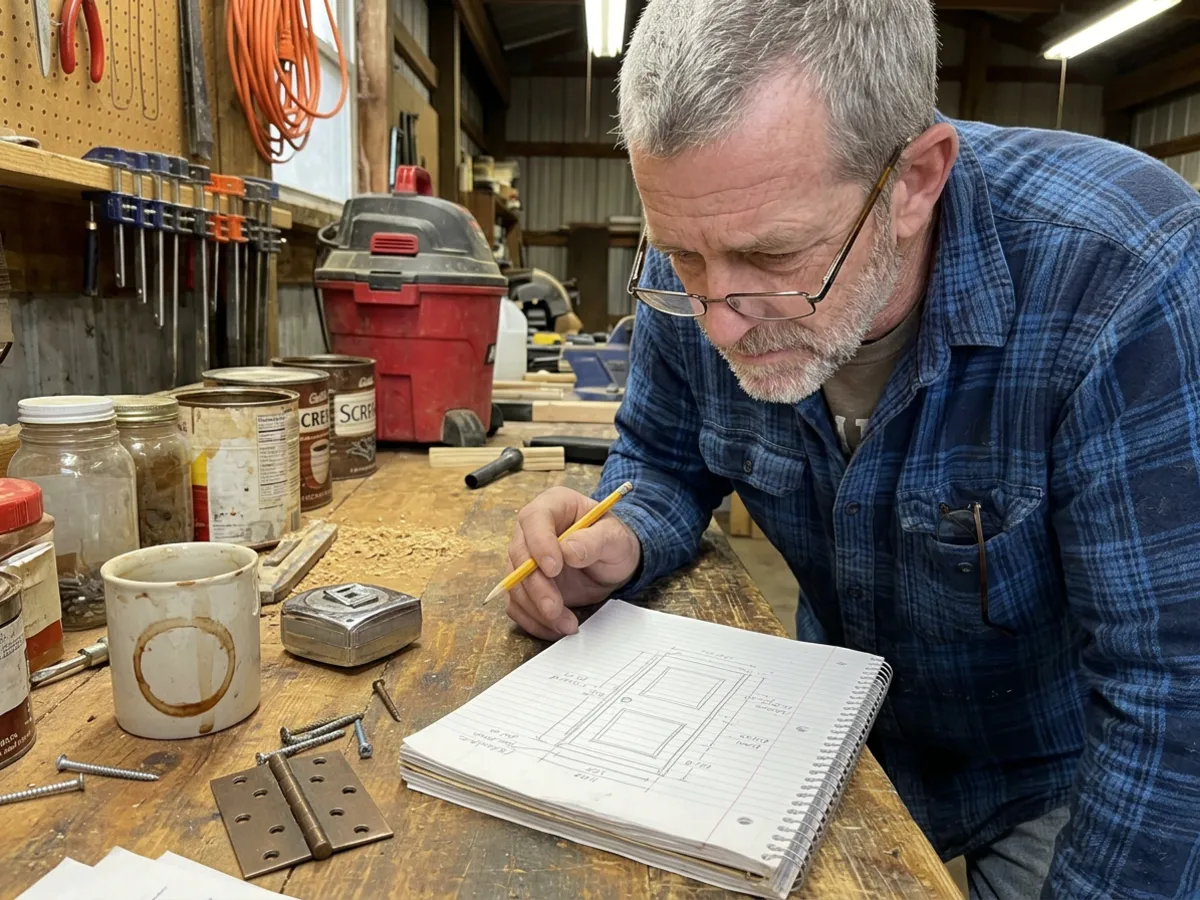
I have a running bit in my family. Every so often I say the words “five-minute fix.”
Nobody believes me anymore. They’re right not to. In thirty-some years, I have never once finished a five-minute fix in five minutes.
This is the story of the most recent one.
The door
Our bathroom door had started sticking. You had to give it a shoulder to close it, and it scraped at the top corner on the latch side. Linda mentioned it on a Friday night. I said, “That’s a five-minute fix. I’ll get it in the morning.”
Linda didn’t say anything. She just smiled the way she does.
Saturday at eight I grabbed a screwdriver. A sagging door usually means the top hinge screws have worked loose. The door droops, and the far top corner rubs the jamb. Tighten the screws, and it lifts back into place.
So I tightened them. Two snugged right up. The third one just spun.
Stripped.
The first trip to town
A stripped hinge screw is not a big deal. There are two good ways to fix it.
The quick way. Pull the screw. Dip a few wooden toothpicks or a golf tee in wood glue, tap them into the hole, and snap them off flush. Let the glue set, then drive the screw back in. It’ll bite like new.
The better way. Replace one of the top hinge screws with a 3-inch screw. Use a hole near the doorstop side so the screw angles into the framing behind the jamb. That long screw grabs the stud and pulls the whole hinge, jamb and all, back where it belongs. On a sagging door this alone often fixes the rub.
I didn’t have a 3-inch screw in the right finish. So I drove to the hardware store.
I was there forty-five minutes. Ten of those were buying the screw. The other thirty-five were spent hearing about a fella’s septic tank. I’ll spare you.
The second trip to town
I got home, put in the long screw, and the door got better. Better, but not fixed. It still kissed the jamb at the top.
At this point I did what I should have done at eight o’clock. I stopped and looked.
I closed the door and studied the gap all the way around. A good door has an even gap, about the thickness of a nickel. Ours was wide at the bottom on the latch side and tight at the top. Then I rubbed a piece of chalk along the jamb and closed the door. The chalk showed exactly where it was rubbing.
Here’s what I found out. The screw had been part of the problem. A long, humid Missouri summer was the rest of it. The door had swelled. Somebody (me, years ago) never sealed the top edge when we hung it. Bare wood soaks up moisture, and that door had been drinking.
So the door had to come off. And I needed sandpaper, which I had, and a fresh can of primer, which I did not. Back to town.
Nobody talked about septic tanks this time. It was worse. It was a fella explaining his new phone.
Taking a little off
With the door off and lying across two sawhorses, I marked the rub line from the chalk. Then I took a hand plane to the top edge.
A word about the top edge. You’re planing across the ends of the side pieces (the stiles), and end grain likes to split out at the corners. Plane from each end toward the middle, and don’t run off the far edge. Take thin passes and check your fit often. You can always take more off. You can’t put it back.
I took off maybe a sixteenth of an inch. Then I eased the sharp corners with sandpaper.
Seal every edge
This is the part most folks skip, and it’s why the problem comes back.
Any edge you plane or cut is bare wood now. Prime and paint it, or seal it with whatever finish the rest of the door has. Get the top and bottom edges too, even though nobody sees them. A sealed door takes on far less moisture, and it’ll stay the size you made it.
Of course, primer and paint need time to dry. So the bathroom door spent Saturday night in my shop, and the bathroom spent Saturday night with an old bedsheet thumbtacked over the doorway.
Linda had thoughts about that.
What I’d do differently
Sunday morning I hung the door. It swung shut with one finger and latched with a quiet click. Even gap all the way around.
Total time: a day and a half and two trips to town. Not counting the septic tank.
Here’s the lesson, and it’s one I keep having to relearn. Look before you grab a tool. Check the gap. Use the chalk. Figure out why it’s sticking before you decide how to fix it. If I’d done that at eight o’clock Saturday, I’d have bought the long screw and the primer in one trip.
It still wouldn’t have taken five minutes. But it might have taken two hours.
Linda says I should start calling them two-hour fixes. I told her that doesn’t have the same ring to it.
Keep your tools sharp, — Dale
Dale’s notes
Get Dale's shop notes by email
Short notes from the shop: projects, fixes, and calm ways to be ready. Plain talk, no spam, and you can unsubscribe anytime.
No spam. Unsubscribe anytime. See the Privacy Policy.