The $8 Yard-Sale Plane That Earned Its Spot on the Wall
There’s a wall in my shop I call the plane wall. Linda calls it something else.
It holds a couple dozen old hand planes. Most came from yard sales and estate sales. I’ve told myself for years I’d restore them all someday. Someday keeps getting pushed back.
A few weeks ago I found another one. It was in a cardboard box at a yard sale, under a waffle iron and a stack of old magazines. A No. 4 smoothing plane, about nine inches long, rusted orange from one end to the other. The fella wanted ten dollars. I offered eight. He looked relieved.
Linda asked where I planned to put it. I said, “On the wall.” She said, “The full one?”
This time, though, I decided to fix it first. Here’s how I brought it back. You don’t need special skills for this, just patience and a flat surface.
Take it all apart
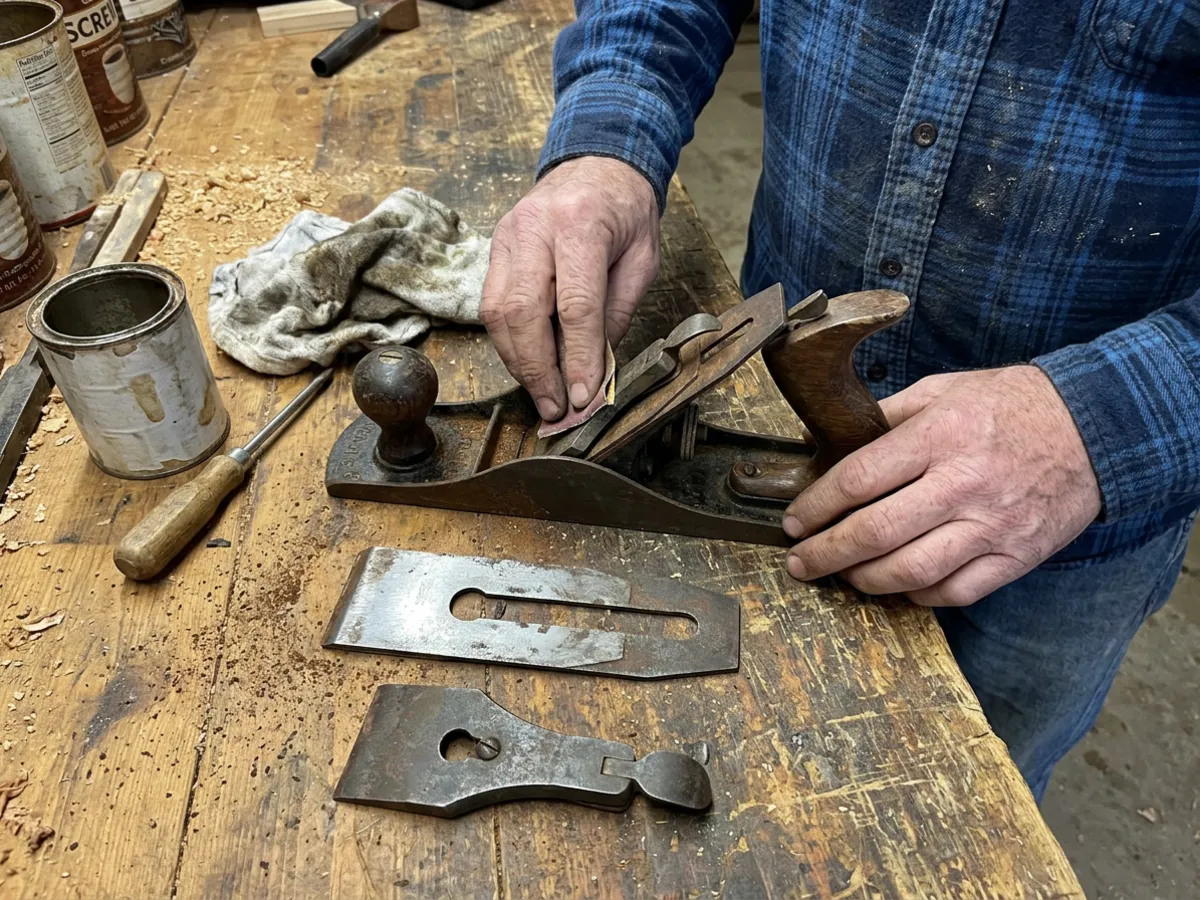
Lay a towel on the bench and take the plane apart. The lever cap comes off, then the blade (folks call it the iron) and the chipbreaker screwed to it. Leave the frog in place for now unless it’s loose or crusted up.
Lay the parts out in order. Take a phone picture. You’ll thank yourself later.
Get the rust off
Light surface rust comes off with a fine abrasive pad and a little mineral spirits or oil. Heavy rust takes more work.
On this one I soaked the iron and chipbreaker in plain white vinegar for a few hours. Vinegar works, but it keeps eating once the rust is gone. Check every hour or so. When the rust wipes off, pull the parts out, rinse them, dry them right away, and give them a light coat of oil. Bare steel will flash-rust overnight if you let it.
I don’t soak the body. Most old planes have a black painted finish called japanning, and long soaks can lift it. I scrubbed the body with a pad and some oil instead and left the old paint alone. A little honest wear never hurt anybody.
Flatten the sole (but don’t overdo it)
Here’s where folks get carried away. The bottom of the plane, the sole, needs to be flat enough to work. It does not need to be a mirror.
Put the iron back in and set the lever cap, but back the blade up so it’s hidden. That puts the body under the same tension it’ll have in use. Then lay sandpaper on something truly flat. A piece of thick glass or a granite tile both work. Start around 120 grit.
Draw squiggly lines across the sole with a permanent marker. Rub the plane back and forth a few strokes, then look. The marker disappears from the high spots first. Keep going until the marker is gone at the toe, the heel, and right around the mouth (the slot where the blade pokes through). A little left in between is fine.
Then step up through a couple of finer grits. I quit at 220. Any finer and you’re polishing for the camera.
Sharpen the iron
A plane is only as good as its edge. An old iron usually needs real work.
First, flatten the back of the iron, just the last inch or so near the edge. Then sharpen the bevel. Most plane irons are ground at 25 degrees. I hone a tiny second bevel a few degrees steeper right at the very edge. It’s quicker to touch up later.
Work through your stones or sandpaper grits until you can feel a small burr along the back of the edge. Then flip it flat on your finest grit and take the burr off. When it’ll slice a sheet of paper cleanly, you’re there.
Fit the chipbreaker
This step makes the biggest difference and gets skipped the most.
The chipbreaker’s front edge has to sit dead tight against the iron. If there’s a gap, shavings jam in there and the plane chokes. Hold it up to a light. If you see daylight, hone the chipbreaker’s front edge on your stone until it meets the iron with no gap.
Set it about a sixteenth of an inch back from the edge to start. Closer for fine finish work.
Put it back together and set it up
Reassemble. Snug the lever cap enough to hold the iron but not so tight the depth adjuster fights you. Sight down the sole from the front and advance the blade until it just peeks out. Even it side to side with the lateral lever.
Rub a little paste wax on the sole. It’ll glide.
Then try it on a scrap of pine. Back the blade off until it barely cuts, then creep it out. You’re looking for a shaving so thin you can almost read through it.
The first good curl came off that plane around two in the afternoon. Buck, who had supervised the whole thing from a pile of sawdust, didn’t even open his eyes.
The lesson
Old tools were built to be fixed. Most of them only need a little time and a flat surface.
That plane cost me eight dollars. It works as well as anything in my shop. It’s got a spot on the wall now, right at eye level. Linda says it’s the only one up there that has earned it.
She may have a point.
Keep your tools sharp, — Dale
Dale’s notes
Get Dale's shop notes by email
Short notes from the shop: projects, fixes, and calm ways to be ready. Plain talk, no spam, and you can unsubscribe anytime.
No spam. Unsubscribe anytime. See the Privacy Policy.