Why Every Tool on My Pegboard Has an Outline
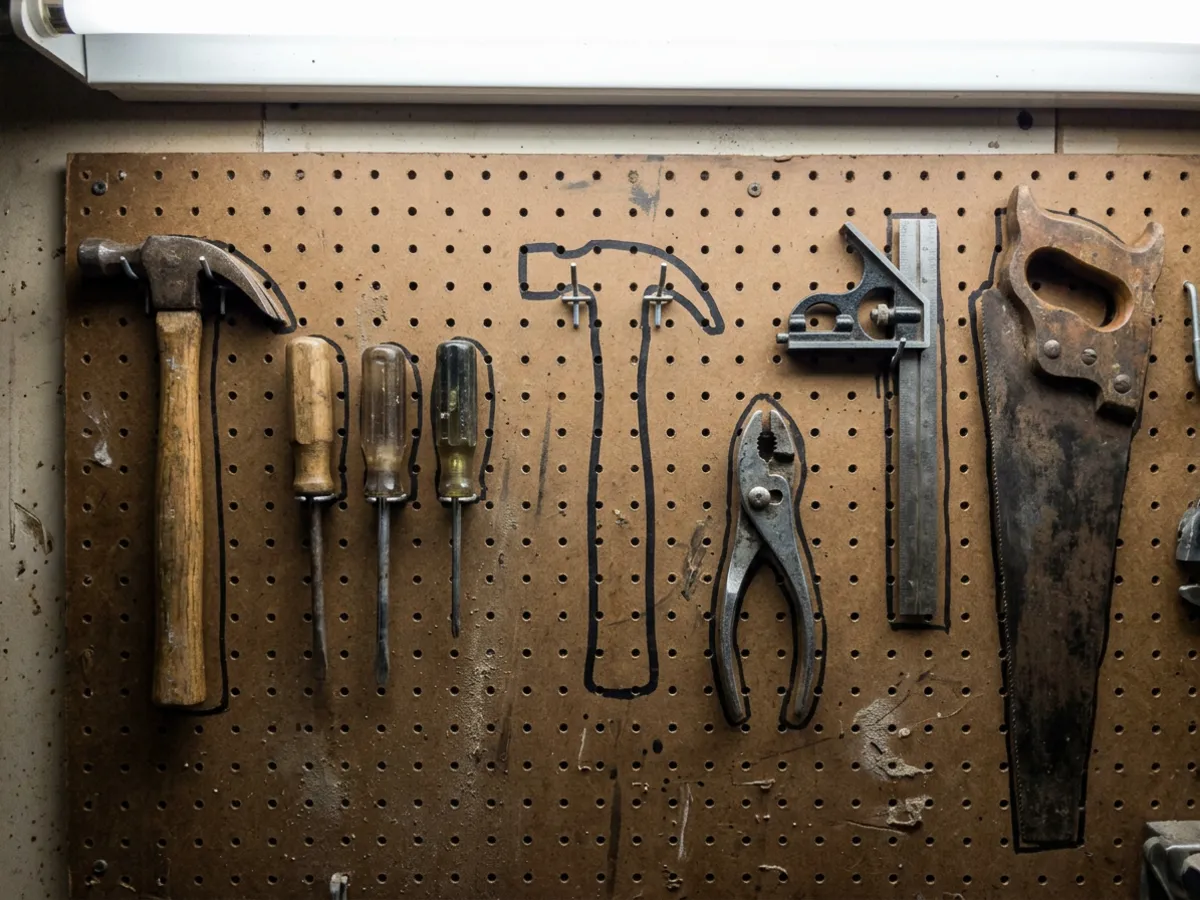
Folks who visit my shop always notice the pegboard. Every tool hanging there has a black outline traced around it.
Earl, my old foreman, saw it the first time and shook his head. “We never needed pictures of our tools in my day,” he said. “We knew where they were.”
Earl has spent a good part of his retirement looking for his tape measure. I didn’t mention it.
How it started
The outlines started with a coping saw.
My grandson Jake is ten. He’s a good helper and he asks great questions, and he borrows tools the way I borrow Linda’s reading glasses. Without asking and without bringing them back.
One summer my coping saw vanished. I looked everywhere. I accused Buck, who was asleep and did not defend himself. About a month later it turned up in Matt’s garage, in a coffee can, next to a half-built birdhouse.
I wasn’t mad. I was glad Jake was building something. But I wanted to know when something walked off, instead of finding out a month later when I needed it.
So I traced everything.
Why outlines work
The old-timers call this a shadow board, and it does three things well.
You see what’s missing at a glance. An empty outline jumps right out at you. You don’t have to take inventory. You just look at the wall.
Things get put back. It’s easier to hang a tool up when there’s a spot that says “hammer goes here.” Even grandkids get it. Lily is five, and she hangs her little pink hammer right next to mine, in an outline she drew herself. It is not a perfect outline. It is my favorite one.
You stop buying duplicates. I’ve bought more than one tool I already owned because I couldn’t find the first one. Measure twice, buy once applies to tools too.
Setting up your own
If you want to do this, here’s what I’ve learned.
Mount the pegboard right
Pegboard needs space behind it for the hooks to go in. Screw it straight to a wall and the hooks won’t seat. Put furring strips behind it first. Strips cut from 1x2 or 1x3 boards give you about three-quarters of an inch of space, which is plenty.
Screw the strips into the wall studs, not just the drywall. Then screw the pegboard to the strips, about every 16 inches or so along each one. A loaded pegboard is heavier than you’d think.
Use the thicker quarter-inch pegboard if you can. The thin stuff sags and tears out around the holes.
Lay it out before you trace
Here’s my rule. The tools you use most go between your belt and your eyes. The tools you rarely use go up high or down low. Heavy tools go low, so you’re not lifting them over your head.
Group tools by job. Measuring and marking in one spot. Cutting tools together. Screwdrivers and drivers together. When you’re in the middle of a project, you’ll reach the right way without thinking.
Hang everything and live with it for a week before you trace. You’ll move things around. Better to move them before the marker goes on.
Trace and fill
I use a black paint marker. It doesn’t smear and it shows up well. Some folks paint the whole silhouette in a solid color, which looks sharp but takes longer.
Hold the tool flat against the board and trace around it. Don’t worry about perfect lines. Nobody’s grading you.
Keep the hooks from falling out
Pegboard hooks have a bad habit of coming out every time you grab a tool. There are locking hooks and little plastic clips made to stop that. A zip tie looped through the board and around the hook works fine too, and costs next to nothing.
The borrowed list
There’s one more piece of my system. A clipboard hangs by the shop door with a pencil on a string. If you borrow a tool, you write it down. Your name, the tool, the date.
Jake writes his name in big capital letters. Matt usually forgets. Earl refuses on principle.
But the coping saw hasn’t gone missing since. Well. Not for more than a week.
A little order goes a long way
None of this is fancy. It’s a sheet of pegboard, some strips, and a marker. Maybe two hours of work.
But every time I walk into the shop and see every outline filled, I feel a little better. That’s what a well-kept shop does for a man. It tells you everything is where it ought to be.
And when an outline’s empty, it tells me who to call.
Keep your tools sharp, — Dale
Dale’s notes
Get Dale's shop notes by email
Short notes from the shop: projects, fixes, and calm ways to be ready. Plain talk, no spam, and you can unsubscribe anytime.
No spam. Unsubscribe anytime. See the Privacy Policy.